
NetworkAccess · Use case
Outage Management System
When the network goes down, the question is never 'where is the asset?', it's 'which fault, which customers, which crew, how fast?' An Outage Management System answers all four from a single live view of your network, so faults are isolated and service is restored in hours, not days.
Get a demo →The stakes
The clock starts the moment a light goes out
An Outage Management System (OMS) is the platform operators run during a fault. It identifies that something is down, localises where, dispatches the right field team, and keeps customers informed, all in real time. Outages caused by storms, equipment failure, or third-party damage (a contractor cutting a duct) can bring operations to a halt; the OMS is the contingency centre that compresses the time between "something broke" and "service is back."
The hard part isn't the alarm. It's knowing exactly which span of fiber failed, what sits downstream of it, and who to send where, fast. That only works if the system already holds a trusted picture of the network: the cable routes, joints, splitters, ports and the customers each path serves. Detection without that map just tells you a light went out; it can't tell you why, or what to do next.
How it works
How NetworkAccess speeds up restoration
NetworkAccess takes an operations-first approach. Instead of starting from a GIS that only shows where assets are, it manages the inventory, serviceability and operational state of the network as one source of truth, so the same platform that knows your fiber paths, ports and capacity is the one running the restoration.
Each step of the response runs against that live model: detected, localised, restored, on one live network record.
Real-time detection
Continuous monitoring flags anomalies the moment they happen, integrating with NMS and field signals for live situational awareness instead of a picture stitched together by phone.
Precise fault localisation
Geospatial intelligence plus network and inventory data pinpoints exactly where a fault sits, which span, which joint, instead of leaving crews to search.
Automated dispatch
Restoration workflows route each fault to the nearest available field team, cutting manual coordination and improving Mean Time to Repair.
Customer communication
A built-in layer pushes restoration progress to affected customers via SMS, email or portal updates, reducing inbound complaints and protecting trust.
Tracing the cut on the network you own
Fault localisation is a trace, not a search. The operator picks the affected point and the tool follows the fibre through the plant it is documented against, drawing the failed run over the imagery of the street it is buried under.
The network-layers panel beside it holds every object class the trace can touch, cables, POPs, towers, poles, manholes, splice closures, FATs, trenches and equipment, so the same screen that shows where the break is also shows what sits either side of it.
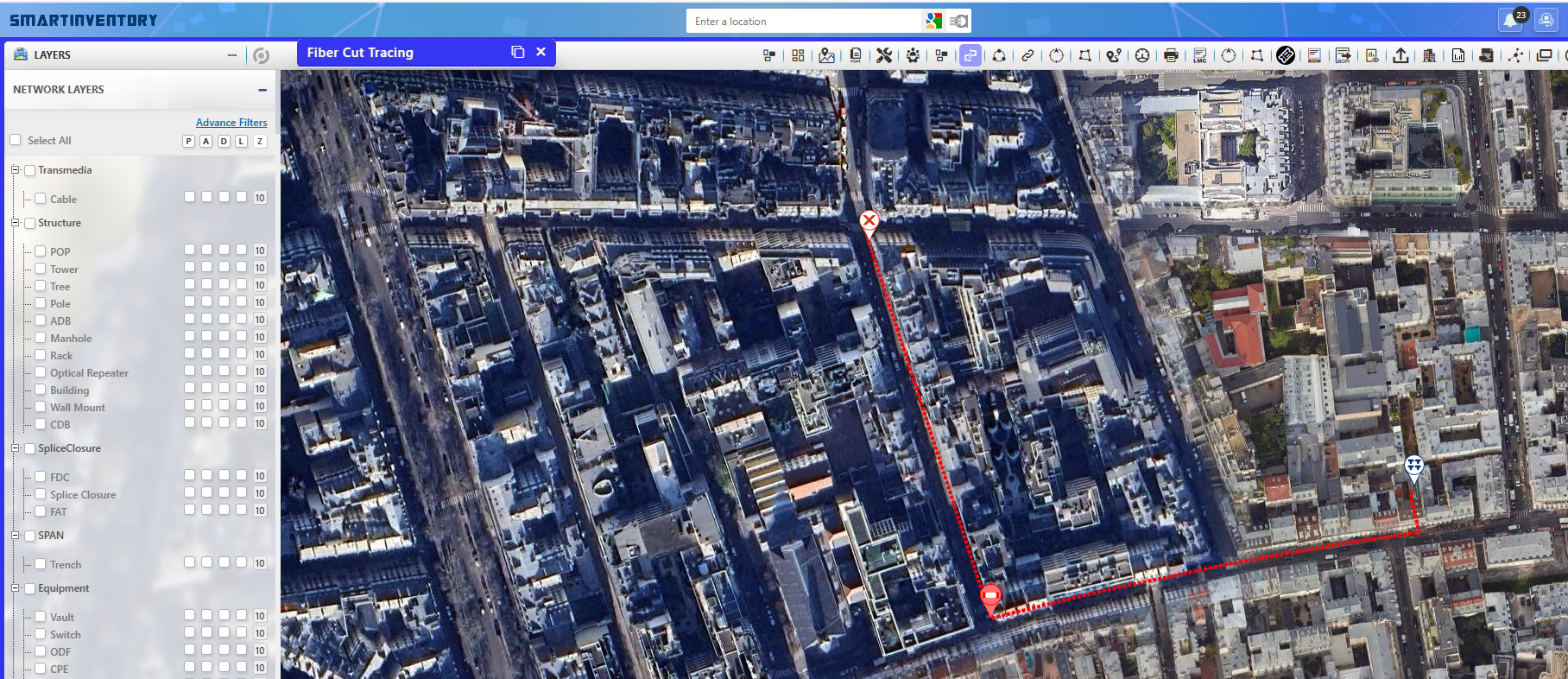
An outage management system that runs on a live network twin.
The same digital twin that holds your fiber paths, ports and customers is the one that detects the fault, routes the nearest crew, and marks the span restored. One live record, from the alarm to the all-clear.
Proof
Proven when the network is on its knees
These outcomes are not projections. They come from real restorations on live networks, including the Cyclone Fani response, where a trusted record of the network turned a chaotic recovery into a tracked workflow.
The gap
Why “where the asset is” isn't enough
Most operators already have a GIS and one or more inventory systems. During an outage those systems often disagree and lack real-time operational visibility, so the map you trust on a normal day is the one you can't fully trust at 2 a.m. in a storm.
NetworkAccess unifies GIS, inventory tools, spreadsheets, CRM and OSS into one operational platform, so restoration runs against a single, current truth instead of three stale ones.
What it changes
What faster restoration changes for an operator
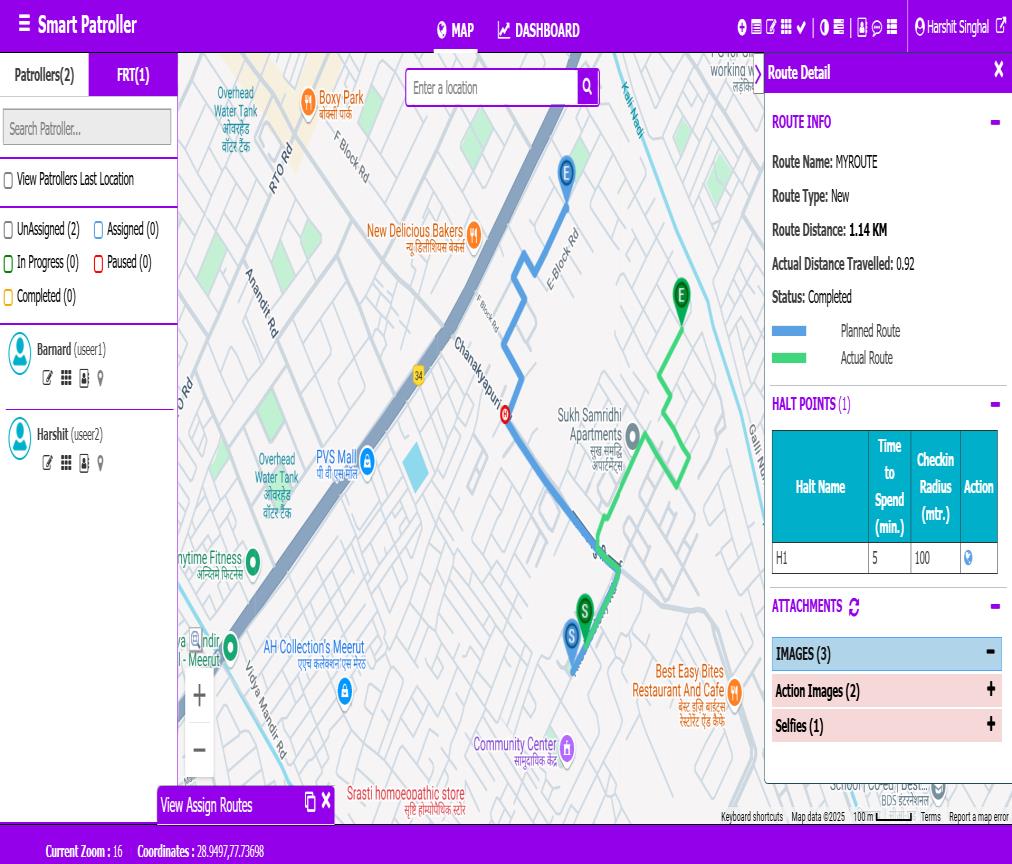
Restoration is judged on the ground, so that is where the difference is visible: the route a patrol was meant to walk, set against the route it actually walked, with each halt timed and evidenced.
SLAs protected, not breached
For telecom operators, fiber cuts and tower outages become a tracked workflow, rapid localisation, dispatch and closure on the platform itself, which protects SLAs and minimises service disruption.
Crews fixing, not searching
A 70-95% reduction in fault lookup time means field teams spend less time finding the fault and more time repairing it, the single biggest lever on MTTR.
Outcomes you can measure
The value shows up where leadership watches: Mean Time to Detect, Mean Time to Repair, outage frequency and post-restoration customer satisfaction all move on the same live model.
Scale
Built for networks at national scale
Outage management is one operational use case of NetworkAccess, the AI-powered fiber inventory and network operations platform. The same digital twin that powers instant serviceability checks and accurate network inventory is what makes restoration fast. The same engine runs under some of the world's largest fiber and telecom networks, so faster fault isolation and restoration hold up at the scale of a national footprint. Explore the full set of NetworkAccess use cases.
- Vodafone
- Reliance Jio
- BSNL
- Tata Play Fiber
- Dialog
See outage management on your network.
Walk through how NetworkAccess turns your network into a live restoration command centre.
Get a demo →