
Use case · Network inventory
Know exactly what network you own
Most operators run several inventory systems that disagree with each other and with what's actually in the field. NetworkAccess unifies them into one trusted digital twin, so you know what assets you own, where they are, and what capacity is available across millions of fiber records.
Get a demo →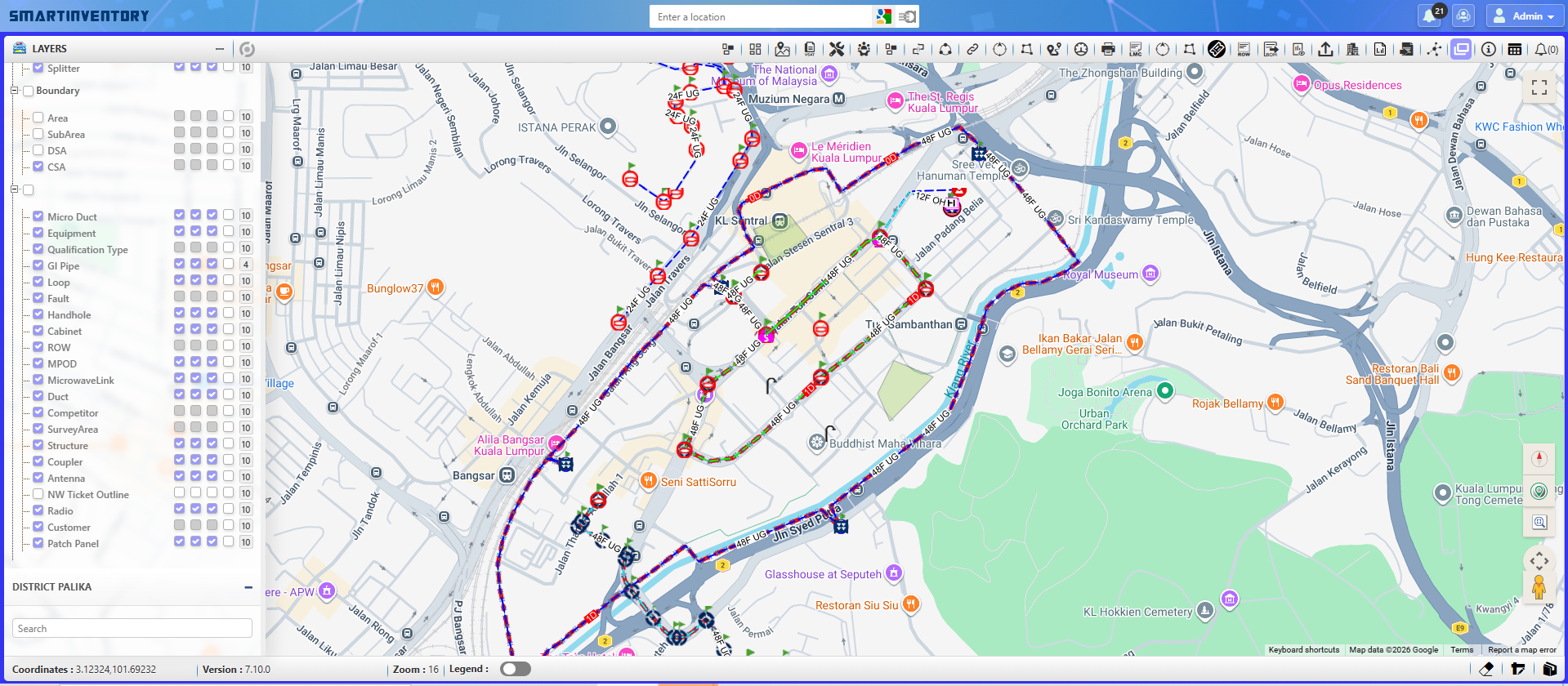
The question
"How do I create a reliable inventory of millions of fiber assets?"
This is the question every Head of Network Operations eventually has to answer. As fiber estates grow into millions of cables, ducts, joints, splitters, OLTs and ONTs, the record of what you own drifts away from what's actually in the ground. Field crews update one system, planners work from another, and a third set of records lives in spreadsheets. The result is data silos: planners build on stale data, duplicate work, and decisions get made on information no one fully trusts.
Having an inventory system is not the same as having an accurate one. Most operators already run several, and they don't agree, and none of them give real-time operational visibility. That gap is exactly where serviceability decisions, capacity planning and capex approvals start to go wrong.
Why records drift apart
Three systems, three versions of the truth
- 01
Where assets sit
The map of where cables, ducts and nodes are placed, often updated on its own cadence.
- 02
Ports and assignments
The record of ports and assignments, which rarely lines up with what GIS shows on the ground.
- 03
Whatever was last typed
The spreadsheet and CRM edits that capture changes no master system ever caught.
One trusted graph of every asset.
Scattered records from GIS, inventory tools and spreadsheets reconcile into a single digital twin. Physical and logical, traced end to end, so every team reads the same network instead of three that disagree.
How NetworkAccess solves it
Operations-first, not GIS-first
NetworkAccess starts from the inventory itself, the assets, their connectivity and their capacity, and treats the map as the interface, not the product. Built specifically for fiber, it models the network out of the box: fiber cables, ducts, joints, splitters, OLTs, ONTs, routes and capacity tracking, with no extensive customization required.
Critically, it brings physical and logical inventory together. Integrating physical inventory with logical inventory has always been an arduous task; NetworkAccess associates a fiber link and all its parameters with the underlying fiber core, then automatically traces it to the connected ports on both sides. That single thread is what makes it possible to display the link on the map, map fiber rings, check protection routes and test bandwidth availability, from one consistent record.
Instead of standing up yet another silo, NetworkAccess unifies what you already have, GIS, existing inventory tools, Excel and CRM, into a single operational source of truth. Field data syncs back to the central system so planners always work from the latest version of the network, eliminating data silos and duplicate work. An end-to-end ticketing lifecycle keeps the record honest: every change, from network survey through as-built updates received from the field, is captured against the twin.
Modelled out of the box
Fiber objects, not generic shapes
- 01
Cables, ducts and routes
Fiber cables, ducts and routes, with planned-versus-as-built clearly distinguished.
- 02
Joints, splitters, OLTs, ONTs
Modelled as first-class fiber objects, not generic shapes dropped on a map.
- 03
Physical-to-logical links
Cores traced automatically to the connected ports on both sides of every link.
- 04
Capacity and bandwidth
Capacity and bandwidth availability tracked against live connectivity, not stale records.
The outcome
What one trusted twin returns
When physical and logical inventory resolve into a single record, accuracy stops being aspirational and reconciliation stops being a standing cost. The numbers below are what operators see when the twin becomes the source of truth.
What a reliable inventory makes possible
- 01
Serviceability in seconds
Once the twin is trusted, serviceability lookups can be answered in seconds instead of waiting on a survey.
- 02
Capacity decisions stop being guesses
With capacity tracked against live connectivity, planning is grounded in what the network can actually deliver.
- 03
Avoid building what you already own
A reliable record helps you avoid spending capex to build network you may already own.
Proof
Proven at national scale
A reliable inventory isn't an end in itself, it's the foundation everything else stands on. This is the same inventory backbone that supports nationwide fiber deployments, managing millions of network assets on a single platform.
- Vodafone
- Reliance Jio
- BSNL
- Tata Play Fiber
- Dialog
Reconcile your inventory on a live network twin.
Walk through how NetworkAccess turns scattered records into one source of truth for your fiber estate.
Get a demo →