
Use case · White space
Enter underserved markets before competitors do
White space is the demand your category has not reached yet: zones where customers are ready to buy, competition is thin, and none of your own stores already cover the catchment. SmartMarket finds those zones across a whole city and explains why each one is open.
Get a demo →The decision
The market you have not reached yet
Every category has demand it does not serve. Customers who would buy if a store were near them, in zones where you have no presence and competitors have not arrived either. That gap is white space, and the brand that fills it first sets the price, the habit and the location everyone else now has to react to.
The hard part is seeing it. White space is invisible to a store-by-store view: it only appears when you hold demand, your own coverage and competitor coverage on the same map at once, and look for where high demand sits with no one serving it.
What white space really means
Three conditions, on one map
A zone is true white space only when all three hold together. SmartMarket tests every part of the city against each of them, so a recommendation is never demand alone or a thin competitor map alone.
Enough demand to justify a store
Footfall, demographics, affluence and category fit point to real, sustained demand in the zone, not a one-off spike.
Few or no rivals already serving it
Competitor outlets are sparse or absent, so the demand is genuinely unmet rather than already captured.
Your own network does not already cover it
A cannibalization check confirms the zone sits outside the drive-time catchments of your existing stores, so a new site adds reach instead of splitting it.
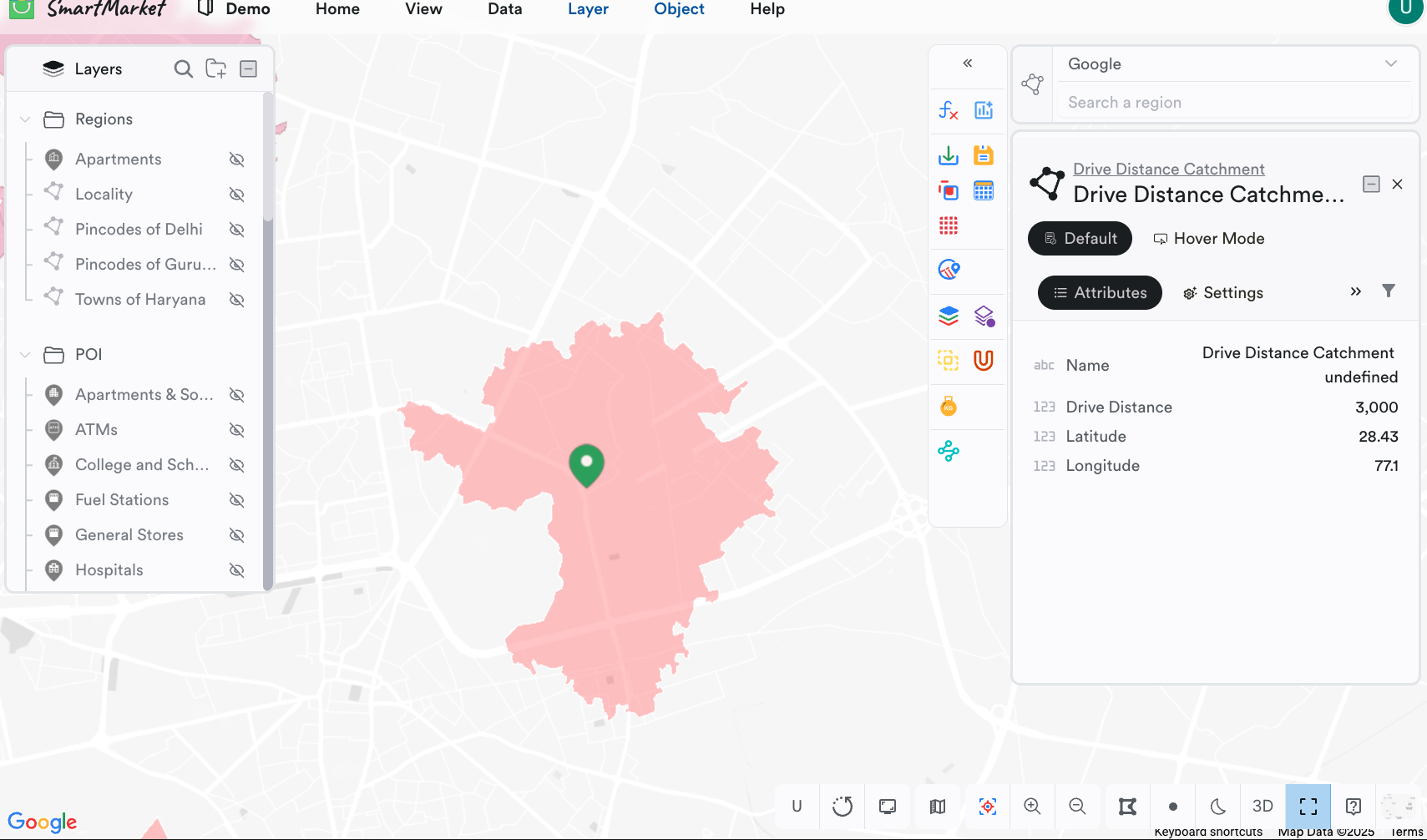
Why a new store can cost you sales
Open in the wrong place and the new store does not win new customers, it pulls them from a store you already own. The drive-time catchments overlap, demand is split between two locations, and total sales barely move while costs double.
SmartMarket models catchment overlap across your whole network before it recommends a zone, so white space is demand you are genuinely adding, not demand you are moving from one address to another.
How SmartMarket finds it
The whole city, scored on a grid
SmartMarket breaks a city into 150m by 150m micro-grids and enriches each one from the Lepton Data Observatory, demographics, affluence, footfall, competitor points of interest and adjacency, with Google Places Insights adding live point-of-interest quality. Drive-time catchments are drawn around your stores, demand and supply are compared cell by cell, and the cells where demand is high, competition is thin and no catchment overlaps surface as ranked white-space zones, each with the reasons it scored the way it did.
The gap, resolved on the map.
Where high demand sits with no catchment over it and thin competition, the white space resolves. A candidate that would overlap an existing store stays dimmed, so first-mover reach never comes at the cost of your own sales.
What finding white space first changes
- 01
First-mover reach
Enter an underserved zone before a competitor does and you set the local default, instead of fighting for share once the market is contested.
- 02
Growth without cannibalization
Every recommended zone clears the catchment-overlap check, so new stores add demand rather than splitting it with the ones you already run.
- 03
An expansion plan you can defend
Each zone comes with the reasons it scored as white space, so the case for the next store is explainable to the board, not a hunch.
The data behind it
Built on live demand and competition data
White space is only as trustworthy as the demand and competition data underneath it. A gap that closed six months ago is not a gap. SmartMarket unifies the Lepton Data Observatory with Google Places Insights for live point-of-interest quality, refreshed monthly, so an underserved grid is underserved now rather than in the vintage of the dataset. The same location-intelligence stack supports work across real estate, retail and BFSI datasets.
- Google Places Insights
- Real estate
- Retail
- BFSI
Find the white space in your market.
Tell us your category and your existing store list, and we will walk through where the underserved, competition-light zones are, and why.
Get a demo →