
NetworkAccess · Use case
5G rollout & densification
5G lives or dies on the network underneath it. Before you densify, NetworkAccess tells you exactly what fiber and capacity you already own near every candidate site, so site serviceability becomes a lookup, not a survey.
Get a demo →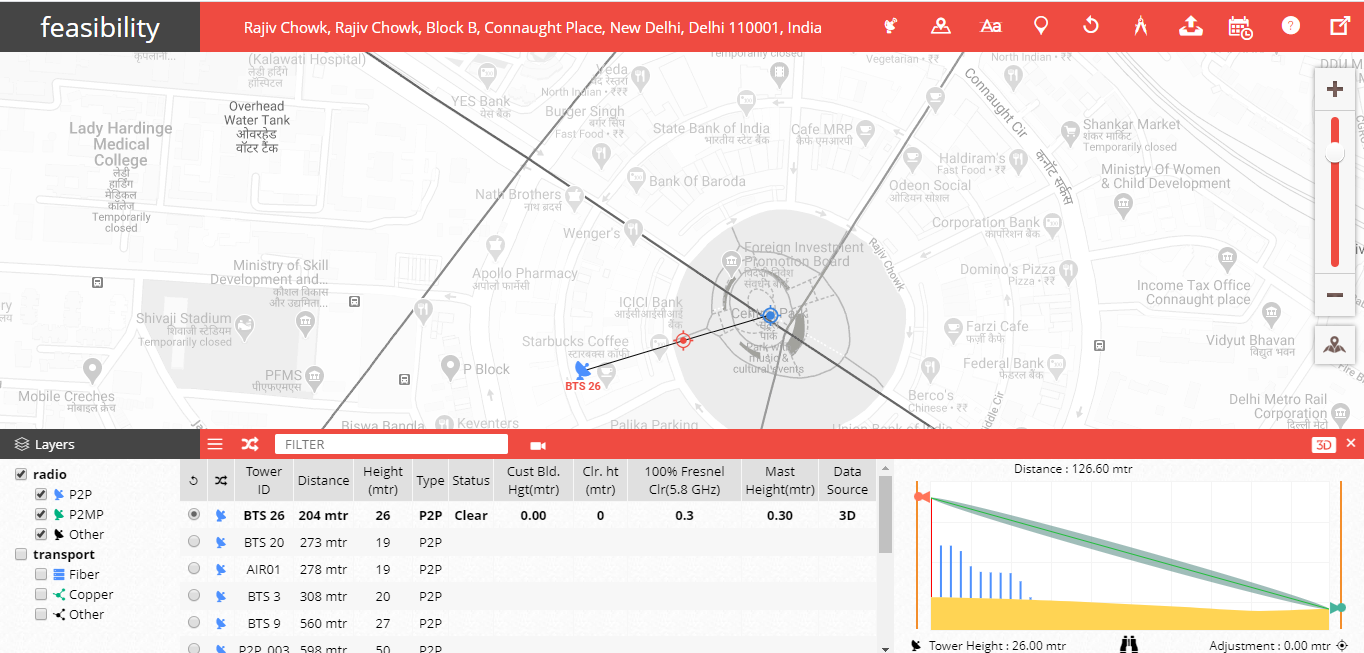
The problem
Why 5G is a network problem, not a radio problem
Rolling out 5G is far more complicated than 4G or previous generations. 5G runs on higher-frequency bands, especially millimetre wave (mmWave), whose signals don't travel far and can't penetrate walls or heavy rain, so operators must deploy far denser small-cell networks, with transmitters every few hundred metres in urban environments. That means thousands more sites, each one a small civil and backhaul project.
The hard question is rarely "where could a cell go?", RF planning tools answer that. The operational question is: "Of the sites we want, which ones can we actually light up with the fiber and capacity we already own, and how fast?" When that answer lives in disconnected GIS layers, inventory systems and spreadsheets that disagree, densification stalls long before the radio is mounted.
How it works
How NetworkAccess answers the serviceability question
NetworkAccess gives you a trusted digital twin of your network, so every candidate 5G site is checked against what you actually own, fiber paths, ducts, splitters, OLTs, ports and the spare capacity on each, instead of a fresh field survey. Serviceability for a site becomes a real-time lookup of backhaul availability and capacity rather than a multi-day exercise.
- 01
Backhaul at a glance
See your existing fiber lines, ducts and backhaul connections for an area on a single operational view, so planners instantly know whether a site sits on or near owned fiber.
- 02
Capacity, not just presence
Knowing fiber runs past a site isn't enough. NetworkAccess tracks available ports and spare capacity so you know the site can carry 5G backhaul before you commit civil works.
- 03
One source of truth
Existing fiber, ducts, sites and capacity sit in one place, giving a unified rollout view with no surprises later, replacing the patchwork of GIS, inventory tools, Excel and CRM operators usually stitch together.
- 04
Operations after launch
Each new 5G site and its backhaul feeds straight back into inventory, so the twin stays accurate and the next densification wave starts from real data, not a stale snapshot.
Site and coverage decisions, made on the live network.
A candidate site qualifies the moment owned fiber and spare capacity reach it. NetworkAccess is the digital twin for your wireless network, so every densification call is read off real backhaul, not a survey queue.
The outcome
The outcome on the rollout
When serviceability is a lookup against live inventory, densification leans on the fiber you already own and the rollout spends its budget where the network can actually carry 5G.
What changes for the operations team
- 01
Build only what you can deliver
With serviceability driven by live inventory instead of surveys, the rollout team spends its time on sites it can actually light up, not ones that stall at the backhaul.
- 02
Densify on owned fiber first
Visibility of what's already owned leans densification on existing fiber before new builds are commissioned, lifting utilization and cutting unnecessary expansion capex.
- 03
Seconds, not surveys
Lookups drop from hours or days to seconds, with real-time visibility of fiber paths, ports and capacity feeding every site decision.
Proof
Proven at national scale
NetworkAccess supports inventory and operational visibility across some of the world's largest fiber and telecom networks, managing millions of network assets across nationwide deployments. Densification decisions driven by live inventory hold up at the scale of a national 5G rollout.
- Vodafone
- Reliance Jio
- BSNL
- Tata Play Fiber
- Dialog
Where planning fits
Plan the radio, then prove the network can serve it
NetworkAccess is the operations and inventory layer 5G sits on, it isn't an RF propagation tool. For coverage modelling, mmWave propagation and 3D line-of-sight analysis, Lepton's RF planning datasets and tools (such as rfMAP) feed high-resolution 3D building models and terrain into industry-standard planners, while NetworkAccess answers the serviceability and capacity questions for the fiber that carries every cell. The two work together: plan the radio, then prove the network can serve it.
Explore rfMAP for RF coverage and 3D geodata, and Lepton for Telecom for the wider operator stack.
Densify on the network you already own.
See how NetworkAccess turns your fiber inventory into instant 5G site serviceability.
Get a demo →