
Use case · Location analytics
Site selection and market analytics on Google's location data
Consumer super-apps, retail networks and public agencies all keep juggling several data sources for one question: where should the next site, store or intervention go? Lepton puts the answer on Google location data in BigQuery, with Places Insights underneath and our own product layer on top.
Get a demo →The question
Where should the next site go?
A retail network deciding the next store, a consumer super-app sizing a new neighbourhood, a public agency choosing where to act: they are all asking one location question. And most of them answer it by stitching together several data sources that never quite agree, then trusting a judgement call to bridge the gap.
The cost is not just slow analysis. It is a site decision made on a partial picture, where the catchment, the competitors and the demand signals all came from different places and none of them refresh on the same clock.
The data underneath
Google location data, queryable in BigQuery
Places Insights brings Google's places dataset into BigQuery, so the catchment, the competitors and the place mix become something you query rather than something you assemble. It covers 250M+ places across 300+ types with 70+ attributes, and it refreshes monthly, so the picture you analyse stays close to the ground. That turns site selection, geomarketing and competitive benchmarking into analytics on one source instead of a reconciliation exercise across many.
- 01
Site selection · Score a candidate before you commit
Read the trade area around a candidate location, the places already in it and the gaps, so the choice rests on the catchment rather than on intuition.
- 02
Geomarketing · Target by where demand actually is
Place types and attributes describe a neighbourhood by what is in it, so campaigns and coverage decisions follow the map instead of broad postcodes.
- 03
Benchmarking · See the competitive field on the same map
Competitors sit in the same dataset as your own footprint, so a benchmark is a query, not a manual market survey.
- 04
One refresh clock · A picture that moves monthly
A monthly refresh means the catchment you scored last quarter is not the one you act on stale this quarter.
From the raw dataset to a product you can run on
Places Insights is the data. SmartMarket is Lepton's product layer on top of it, so site selection and trade-area analysis arrive as a tool your teams use rather than as queries your analysts have to author from scratch.
It is the same pattern across our portfolio: take the newest Google location data and put a product around it. For road authorities and utilities, Roads Management Insights does the same job, and Lepton resells it as Trafficure.
Explore SmartMarket or see Trafficure for road authorities.
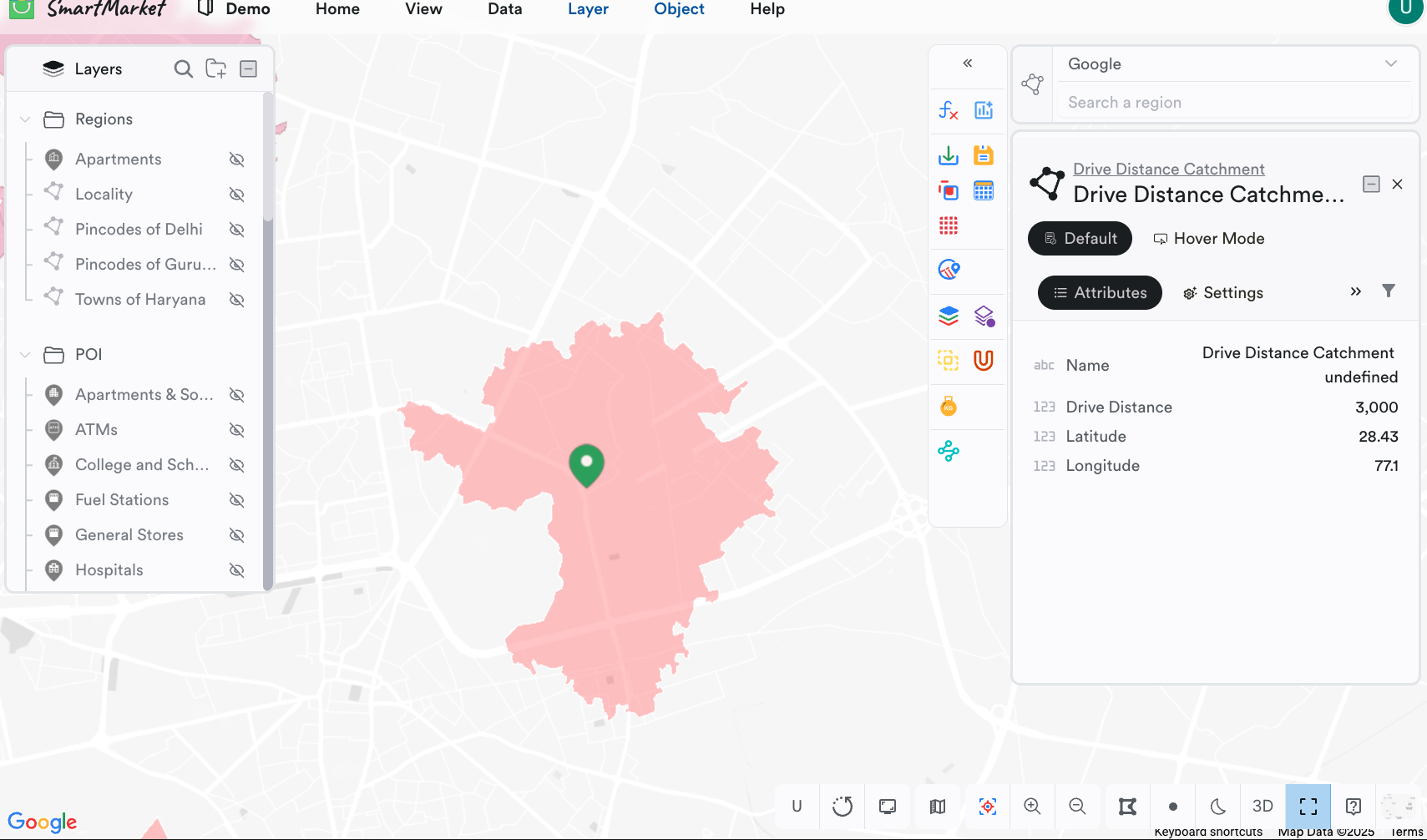
The trade area lights up around the site you are choosing.
Scattered places stop being a list and become a catchment: 250M+ places, 300+ types and 70+ attributes in BigQuery, refreshed monthly, resolved into the cell around the candidate location you are about to commit to.
What we deliver
The data, wired into the stack you can act on
Places Insights lives in BigQuery, and most teams want it sitting next to the rest of their analytics rather than as a one-off export. Lepton does that integration: the BigQuery setup, the GCP project and access, and the wiring into the stack you already run, with Vertex AI for forecasting and Looker for dashboards when the use case calls for it. The result is location analytics your teams query alongside everything else, not a separate report someone has to commission.
What running on one location dataset changes
One source, not a stitch job
The catchment, the competitors and the place mix come from one dataset on one refresh clock, so the site decision stops resting on sources that disagree.
A product, not a project
SmartMarket puts site selection and trade-area analysis in your teams' hands, so the analysis is a tool you run, not a study you commission.
The same pattern for road authorities
Road authorities and utilities get the equivalent through Roads Management Insights, which Lepton resells as Trafficure.
Proof
We ship products on this data, not just access to it
Most teams meet Places Insights as a dataset to evaluate. We meet it as the layer two shipped products already depend on. SmartMarket scores trade areas on it, Trafficure reads Roads Management Insights for citywide congestion, and both had to survive the parts a demo never shows: the BigQuery pipeline, the polygon and filter query architecture, the monthly refresh, and the cost of querying 250M+ places at the volume a national rollout asks for. That is the work you get when you take the data through us.
- Google partner 15+ years
- Premier Partner 15+ years
- Asia's largest GMP reseller
- BigQuery pipeline setup
- Polygon query architecture
- SmartMarket and Trafficure
Run your next site decision on Google location data.
Bring the market you are sizing. We will scope Places Insights in BigQuery against your real catchments, and show where SmartMarket fits.
Get a demo →